
Last updated September 11, 2026
Full 25-point door and opener safety check with every visit - springs, cables, rollers, tracks, and your LiftMaster or Chamberlain opener included
You get a price before we start. It does not change when the truck arrives.


 Before
 After
After Before
 After
After Before
 After
AfterGarage Door Warning Signs: A Cedar Park Homeowner’s Reference Guide
Here’s something most Cedar Park homeowners don’t realize: your garage door talks to you every single time it opens. Most of us ignore it until the thing flat-out refuses to move. A door that hesitates for two seconds before lifting isn’t “just doing that” - it’s an opener straining against a balance problem that’s roughly three months away from burning out the motor. A creak you hear every morning isn’t the door settling in; it’s metal fatigue announcing itself. This guide walks you through seven specific warning signs, ranked from “keep an eye on it” to “stop using the door today.” By the time you finish, you’ll know which noises to ignore, which ones to act on, and when a problem that costs $80 to fix today becomes a $1,200 emergency next spring.
Quick Answer
The most common garage door warning signs in Cedar Park are unusual noises (grinding, popping, squealing), a door that hesitates or runs unevenly, visible cable fraying, a door that reverses unexpectedly, increased opener strain, and gaps in the door’s travel path. Any of these means the door is telling you something before it fails completely. The smartest move is to address the early signs when repairs are cheap and same-day rather than waiting for a broken spring at 9 p.m.
Table of Contents
- The Audible Warning Sign Ladder: What Every Noise Means
- The Hesitation Sign: When a Two-Second Pause Matters
- Cable Fraying: The Visual Check You Can Do From Standing Height
- Sensor Misalignment vs. Track Problems: Telling Them Apart Without Calling Anyone
- Why Your Door Runs Slow on Cedar Park Mornings: Spring Fatigue and Temperature Cycling
- The Door That Reverses Unexpectedly: A Life-Safety Issue, Not a Nuisance
- Opener Strain: When the Motor Is Working Too Hard
- Common Mistakes to Avoid
- When to Call a Professional
- Frequently Asked Questions
- The Bottom Line
The Audible Warning Sign Ladder: What Every Noise Means
Garage doors make noise. That’s normal. What’s not normal is a new noise, or a noise that changes pitch, frequency, or volume over time. In our experience across Cedar Park neighborhoods - Buttercup Creek, Ranch at Brushy Creek, Forest Oaks, Twin Creeks - most door failures announce themselves audibly weeks before they happen. Homeowners just don’t know what they’re listening to. Here’s the ladder, from informational to urgent.
Informational Noises (Monitor, Don’t Panic)
- A low rumbling hum from the opener: This is normal for belt and chain-drive openers. If the volume is consistent and the door moves smoothly, you’re hearing the motor doing its job.
- A single soft thunk when the door reaches fully open: The door is hitting its stop. If it’s not violent, it’s normal.
- Light squeaking: Often just a hinge or roller that wants lubrication. A silicone-based garage door lubricant on the hinges, rollers, and springs twice a year handles most of this. (Do not use WD-40; it’s a solvent, not a lubricant.)
Urgent Noises (Schedule a Service Call)
- Grinding from the rollers or track: Metal-on-metal grind means a roller is wearing out or the track has shifted. Left alone, the roller seizes and the door jams cockeyed in the track. In Cedar Park’s summer heat, this accelerates - heat causes track metal to expand, tightening clearances that were already marginal.
- Popping or creaking from the spring area: That’s a torsion spring binding inside its coils. A spring under tension doesn’t creak - it’s quiet. If you hear creaking from above the door, the spring is moving in ways it shouldn’t.
- Rhythmic rubbing on one side only: The door is out of balance and the roller is dragging against one track. Every open cycle wears that roller, that track, and the other side that’s compensating.
Stop-Using-the-Door-Today Noise
A sharp, loud bang or gunshot-like crack from anywhere near the door. That’s a spring letting go. The door is now held up by the opener alone (if at all), and if you have a car inside, it’s staying there until the spring is replaced. A door is 200 pounds riding on two springs. Respect it. If you hear that bang, do not try to open the door manually by yanking on it - the remaining spring can still release. Call a professional who works with high-tension springs every day. This is not a DIY repair. Torsion and extension springs under load carry enough stored energy to cause serious injury or worse if handled incorrectly. We count spring cycles the way you count tire miles - and a broken spring tells us exactly what was left on yours.
The point of this ladder is simple: noise is data. The earlier you act on urgent noises, the smaller the repair. A Garage Door Repair in Cedar Park visit for a worn roller set and balance adjustment costs a fraction of what a snapped spring and bent track panel run.
The Hesitation Sign: When a Two-Second Pause Matters
Here’s a scenario we hear all the time from Cedar Park homeowners: “The door pauses for a second or two after I hit the button, then it goes up. Is that a problem?” Short answer: yes, and it’s a bigger problem than most people think.
A door that hesitates before moving is telling you the opener’s motor is being asked to overcome resistance it wasn’t designed for. Modern openers from Chamberlain and Genie have a startup routine that ramps the motor up to speed in about half a second. When the door is properly balanced, the motor does minimal work - the springs do the heavy lifting. When a door hesitates, the motor is working against a spring that’s losing tension, a roller that’s binding, or a panel that’s dragging. That extra load burns out opener motors faster than anything else in the system.
Think of it like driving with your parking brake halfway on. The car still moves. The engine is working harder than it should. And one day, usually on the hottest afternoon in July or the coldest morning in February, it doesn’t.
What we’ve seen in Cedar Park specifically: the summer-to-winter temperature swing puts extra stress on torsion springs. A spring that tested at full tension in March may be down 15% of its rated strength by October. That 15% is the difference between a door that lifts smoothly and a door that hesitates. The fix is often a spring adjustment or replacement - not an opener replacement. If the opener is straining, the problem is almost never the opener.
Garage Door Opener repairs in Cedar Park are often misdiagnosed when the real culprit is the spring. That’s why we always check balance before we ever touch the opener.
Cable Fraying: The Visual Check You Can Do From Standing Height
You don’t need a ladder to check your cables. You don’t need tools. You need to stand in your garage, look at the left and right sides of the door, and actually look at the cables. Most people never do this until one snaps.
Here’s what you’re looking for: the cables are the two steel wires that run along the outside edges of the door, from the bottom brackets up to the spring assembly. On a healthy door, they’re straight, taut, and uniform in color. On a door in trouble, they look different.
What fraying actually looks like before it snaps:
- Individual strands poking out from the main cable body, like a worn bristle brush. The cable is made of dozens of fine steel strands twisted together. When individual strands break loose, the cable is telling you it’s beyond its service life.
- A fuzzy or “hairy” appearance along any section of the cable. That’s not dust; that’s broken strands the eye can’t resolve individually.
- Discoloration or rust spots near the bottom bracket - the cable is corroding where it takes the most stress. In Central Texas, humidity plus garage chemicals (fertilizer, pool supplies) can accelerate this.
- A visible reduction in cable diameter compared to the other side. If one cable looks thinner, it’s about to give.
Three checks you can do right now:
- Close the door fully. Look at both cables. Are they straight? Is one slack while the other is taut? Slack on one side means the door is out of level and the taut cable is taking double load.
- Run your eye up and down each cable slowly. Look for any spot that catches light differently - that’s a wear point.
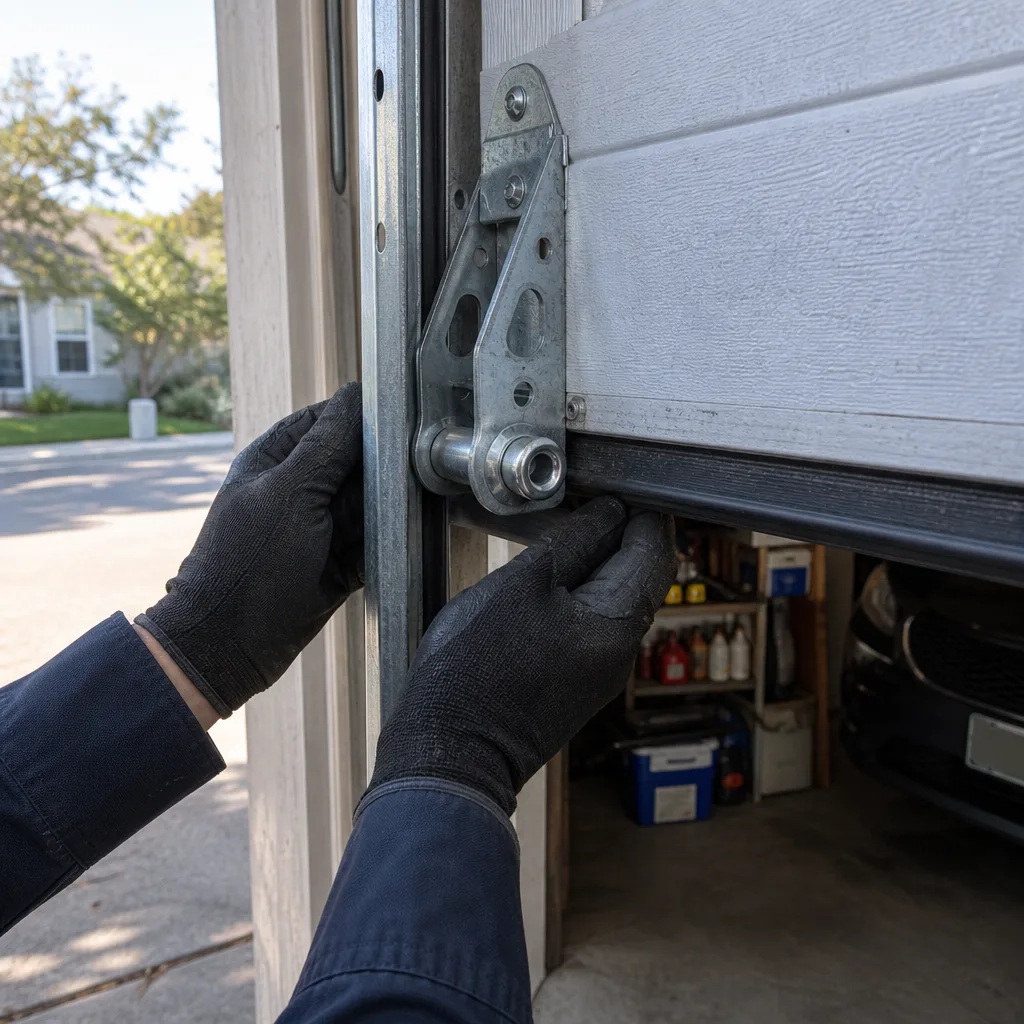
- Look at the bottom brackets where the cable attaches. This is the most common failure point. If the bracket is cracked, bent, or the cable looks pinched, stop using the door and have it checked same-day.
A frayed cable under load is a loaded weapon. When it snaps, the broken end can whip across the garage with enough force to injure anyone nearby. If you see fraying, don’t try to tighten, adjust, or replace anything yourself. The tension on that cable is measured in hundreds of pounds. This is a time to call someone who works with these every day, not to experiment.
Sensor Misalignment vs. Track Problems: Telling Them Apart Without Calling Anyone
Your door refuses to close. The opener lights blink. The door reverses back up. Half the time this is a five-minute fix you can do yourself. Half the time it’s a track issue that needs real service. Here’s how to tell them apart from a standing position, without tools.
The photo-eye sensors sit at the bottom of the door opening, one on each side, about six inches off the ground. They shoot an invisible beam across the opening. If that beam is broken, the door won’t close. It’s a life-safety feature - the beam detects anything in the door’s path, including a child, a pet, a lawn chair. The system works, and you don’t want to defeat it.
The Sensor Check (Two Minutes, No Tools)
- Look at the small lights on both sensors. Most sensors have a small LED. On many Chamberlain and Genie units, both lights should be solid. If one is blinking, flickering, or dark, that sensor isn’t seeing the beam.
- Check if the lenses are dirty. Dust, spider webs, grass clippings - anything on the lens can break the beam. Wipe each lens with a dry cloth. Try the door again.
- Check alignment. Give each sensor a gentle nudge. They should be facing each other straight on. If a broom, a stroller, or a kid’s bike bumped one, it’s now aimed at the wall instead of the other sensor. Adjust until both lights go solid.
If you do all that and the door still reverses, you’re looking at a track problem, not a sensor problem. Here’s the giveaway: a track issue usually makes noise or shows visible signs. Look at the tracking on the inside edges of both vertical tracks. If the tracks have deep scratches, flats spots, or visible gaps where sections of track meet, the door’s rollers are fighting the path. Check for panel damage too - a door that got backed into (even lightly) by a car will often refuse to close because the panel is binding in the track, and the sensors aren’t the issue at all.
The distinction matters because of cost. Sensor fix: free, or the price of a cloth. Track repair: labor and likely replacement parts. If you’re not sure which one you have, we’ll tell you straight over the phone at (737) 383-3934 - describe what you see and Otto will walk you through the two-minute check before anyone gets in a truck.
Why Your Door Runs Slow on Cedar Park Mornings: Spring Fatigue and Temperature Cycling
“It only happens in the morning.” We hear this from homeowners all over Cedar Park, and it’s not their imagination. A door that’s sluggish in the early hours and fine by afternoon is showing you something specific about spring fatigue in a temperature-cycling climate.
Here’s the mechanics. Torsion springs operate by twisting and untwisting. They’re rated by cycle count - how many open-close cycles they’re designed to last. Standard springs run 10,000 cycles. Higher-end springs run double that. But the behavior of a spring changes with temperature, and that’s where Cedar Park’s climate comes in.
Cedar Park routinely swings 30 to 40 degrees between early morning and late afternoon. A garage door in an uninsulated garage sees that full swing. When metal gets cold, it becomes incrementally stiffer and marginally shorter. When it warms up, it expands and loosens. A spring that was installed at 4 p.m. in June will perform differently at 6 a.m. in December. Not a huge difference - but enough that a spring already down on tension shows it in the morning first.
A door that’s slow in the morning but normal by noon is telling you: the spring has lost tension and is closer to failure than you think. When you combine age (most springs last 7-12 years depending on cycle count) with daily temperature swings, you get a door that’s borderline in the morning and “fine” by evening. That borderline condition is exactly when a replacement spring is cheap and scheduled, not an emergency.
What you can do: stand in the garage and watch the door move. If it pauses at the bottom, or the opener audibly labors in the first few inches of travel, note it. Call a Garage Door Installation specialist in Cedar Park and tell them what you’re seeing. A torsion spring balance test takes minutes and tells us exactly how much life is left. If the answer is “not much,” replacing the spring now costs a fraction of replacing the spring plus a bent panel plus a burned-out opener after it fails at the worst possible time.
The Door That Reverses Unexpectedly: A Life-Safety Issue, Not a Nuisance
Your door is closing, and then it isn’t. It reverses partway down and heads back up for no apparent reason. The first reaction most people have is frustration: “It’s doing it again.” The second reaction should be gratitude, because the door is telling you the safety system is working.
A door that reverses unexpectedly is doing so because something told the opener to stop. That’s the photo-eye beam being broken, the force-sensitivity setting detecting resistance, or the door encountering an obstruction in the track. But here’s the critical part: a door that reverses without an obvious obstruction is a door with a developing problem, not a random glitch.
There are two checks you should run every time this happens:
- Check the photo-eye path physically. Is there anything in the direct line between the two sensors? A leaf, a toy, a cardboard box corner, a spider web. Anything that breaks the beam, no matter how small. If you clear it and the door closes normally, you’re done. This was the system working as designed.
- Check the door’s travel path visually. With the door about halfway up, stand inside the garage and look along the inside of both tracks. Is anything protruding into the path? A bent track section, a loose bracket, a panel section that’s bowing outward? If the door’s edge or a roller catches that obstruction, the opener reads it as resistance and reverses.
If both of those check out clean and the door still reverses at the same point every time, you may have a spring or balance issue that’s causing the door to stall mid-travel. The opener’s force sensitivity is calibrated for a balanced door; when the door is out of balance, the opener senses it and reverses. The fix here is not to adjust the sensitivity dial - that defeats the safety mechanism. The fix is to correct the balance.
Here’s why this is a life-safety issue and not a nuisance: every time that door reverses, it’s because a built-in system is detecting a problem. If you disable or ignore that system long enough, the door stops reversing and starts crushing. Garage doors are the heaviest moving object in most homes. A 16-foot Clopay or Amarr door can weigh 200 to 400 pounds, and a door that’s decided not to stop is a serious hazard to people, pets, and vehicles. Take the reversal seriously. If it happens twice in a week, call us at (737) 383-3934 and describe when and how it reverses - we can usually tell you over the phone whether it’s a beam issue or a balance issue.
Opener Strain: When the Motor Is Working Too Hard
Most opener motors are rated for about 1/2 horsepower, and that’s generous for a properly balanced door. The opener isn’t supposed to do the heavy lifting; the springs are. When the springs fade, the opener is doing work it was never meant to do, and the motor lets you know.
Symptoms of opener strain include: the opener running hot to the touch after a single open-close cycle, a noticeable change in motor pitch (higher or rougher), a burning smell from the motor housing, or the opener tripping its thermal cutoff mid-cycle on hot days. In Cedar Park, where garages regularly hit 100+ degrees in summer, an overworked opener motor can trigger its thermal protection and simply refuse to work until it cools down - usually right when you need to leave for work.
The crucial insight is that opener strain is almost never an opener problem. It’s a spring problem, a roller problem, or a track problem that’s been left too long. We see homeowners replace openers at big-box store prices only to watch the new opener strain exactly like the old one, because the underlying problem was never fixed.
Before you buy a new opener, watch the door with the opener disconnected. Pull the manual release (usually a red cord hanging from the opener rail) and lift the door by hand. A healthy door should lift smoothly with one hand, stay in place at halfway, and not slam shut when you let go. If you can’t lift it easily, or it wants to fall, the problem is the door balance - not the opener. Reconnecting the opener and replacing the opener without fixing the balance is spending $300 to $600 solving nothing.
That’s the kind of thing we’d rather tell you on the phone for free than sell you a repair you don’t need. The name on the van is the name on the invoice and the name on the license, and Otto has been answering his own phone in this county since 2004.
Common Mistakes to Avoid
- Ignoring noise changes for months. A door that goes from quiet to creaking to grinding over a six-month span is walking through the warning ladder. Each step ignored makes the final repair more expensive. We have seen $90 roller replacements turn into $900 panel and track jobs because the grinding was “just the door being old.”
- Lubricating to fix a mechanical problem. Some Cedar Park homeowners spray WD-40 on a noisy spring and call it maintenance. The noise comes back, and now the spring is slippery. Lubricant is for prevention, not repair. If the noise persists after lubrication, the part is worn, not dry.
- Adjusting the opener’s force sensitivity to “fix” reversal problems. This is the most dangerous thing on this list. The sensitivity dial is a safety calibration. Crank it up to stop the reversal, and you’ve just told the door it’s okay to close on whatever is in the way.
- Waiting until both springs fail to replace either. Springs wear evenly. If one lets go, the other is usually close behind. Replacing both at once is standard practice and cheaper labor-wise than two separate service calls. It also prevents a second failure in six months.
- Trying to shorten a frayed cable or patch it. Cables hold hundreds of pounds of tension. There is no safe patch. There is no safe DIY replacement. This is always a call to a professional.
- Assuming a new opener fixes a strained opener. The opener is the symptom, not the cause. If the door doesn’t balance by hand with the opener disconnected, the problem is the door, not the motor.
When to Call a Professional
Some things are worth doing yourself. Cleaning photo-eye lenses, checking for obstructions, doing the visual cable check from standing height - these are homeowner jobs. Other things are not. If you hear a loud bang, see a visibly frayed cable, notice a door that won’t balance by hand with the opener released, or have a door that reverses at the same point every time despite clear sensors, call a professional. Torsion springs, cables, and track systems carry enough stored energy to seriously injure anyone working on them without proper training and tools. Otto’s Garage Door offers free estimates in Cedar Park - call (737) 383-3934. We’ll tell you what we see, quote the job before we start, and the price we quote is the price you pay. No surprises at the door.
Frequently Asked Questions
Most garage door repairs in Cedar Park run between $90 and $350 depending on the part and labor, with spring replacement typically $180-$340, roller replacement $90-$200, and track realignment $120-$250. These are the ranges we work with every day. Call (737) 383-3934 for an exact quote on your specific door and issue - estimates are free, and the price we quote before the visit is the price we hold at the door.
Yes. We answer calls live, 24/7, and we schedule same-day service in Cedar Park for urgent issues like broken springs, snapped cables, and doors that won’t open or close. A live person - often Otto himself - will answer your call, quote the job over the phone, and hold that number when we get there.
No. We quote the job on the phone or at the free estimate, and the price is agreed before any work starts. That’s the handshake. If we find something else that needs attention, we’ll show you, explain it, and give you a separate number before we touch anything. Since 2004, Otto has lived by the rule that the price he gives is the price you pay.
Yes. Our trucks carry a full range of torsion and extension springs, cables, rollers, hinges, brackets, sensors, and opener parts for all the brands we service - Chamberlain, Genie, Clopay, Amarr, and more. Most repairs are done in one visit because the part is already on the truck when we arrive.
A standard torsion spring is rated for about 10,000 cycles, which translates to 7 to 12 years for most Cedar Park homes depending on how often the door is used. Temperature swings in Central Texas age springs faster, so a spring that’s 8 years old and showing morning sluggishness may be at the end of its life even if it hasn’t snapped yet.
A burning smell from the opener motor housing usually means the motor is overheating from running against a door that’s out of balance. Stop using the door and call a professional. In a worst case, the opener can seize entirely and the door is stuck until the balance problem is corrected. We can diagnose this over the phone at (737) 383-3934.
No, and that’s a problem in this industry. Ask any repair company what they guarantee in writing. Our standard is the 90-Day Done Right Promise: ninety days in writing on every garage door job. If it’s not done right, we make it right. One call brings Otto back, no runaround.
Yes. Senior and Veteran 10% discount - always. We’ve offered it since the beginning, and it’s not a promotion; it’s who we are. If you’re a senior or a veteran in Cedar Park, mention it on the phone and we’ll apply the discount. No questions, no fine print.
The Bottom Line
Your garage door tells you when something is wrong. Listen to the noises - a creak is data, a bang is a warning. Watch the hesitation, the slow morning starts, the unexpected reversals. Check the cables before they check out. Most garage door emergencies in Cedar Park don’t happen suddenly; they happen after months of ignored warning signs. Act on the early signs and you’re looking at a scheduled repair that costs under $200. Ignore them and you’re looking at a middle-of-the-night emergency that costs five times as much. Otto’s Garage Door is locally owned and owner-operated, based right here in Cedar Park. Call (737) 383-3934 and a real person answers. We’ll give it to you straight.
Written by Otto Reinhardt, Owner at Otto’s Garage Door, serving Cedar Park since 2004.
Otto’s Garage Door home | Garage Door Repair in Cedar Park | Garage Door Installation in Cedar Park | Garage Door Opener in Cedar Park